
LONG ISLAND · CABINET & STORAGE PLANNING
Are Custom Cabinets Worth It for Your Long Island Home?
Custom cabinets can be worth considering when a specific size, storage need, or design detail cannot be met well by an available cabinet line. If your existing layout works, a cabinet update or a simpler fitted-storage project may deserve a closer look first. Start with the problem you want to solve, then compare the options.
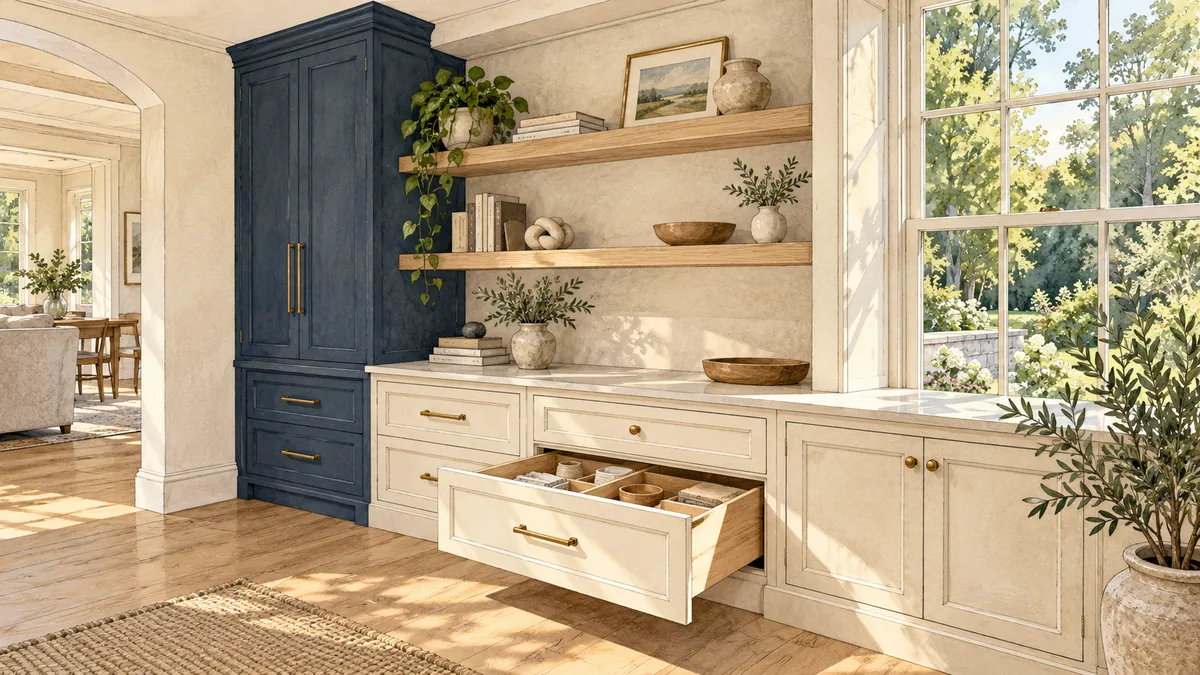
The decision in three questions
- Is the problem fit? Ask whether standard dimensions leave a meaningful storage or layout problem.
- Is the problem function? Define what you need to store and how you want to reach it before selecting doors and finishes.
- Is the problem appearance? If the layout and cabinet condition are suitable, compare an update before assuming you need all-new cabinetry.
Custom, semi-custom, stock, or an update?
“Custom” should describe a useful design choice, not end the comparison. MasterBrand’s explanation of cabinet types distinguishes stock cabinets in common sizes, semi-custom lines with more options, and custom work with broader modification choices. Ask what those labels mean in the particular proposal you receive.
| Option | Start here when | Question to resolve |
|---|---|---|
| Stock cabinet line | Available sizes and finishes suit the room. | How will the layout handle corners, fillers, openings, and installation? |
| Semi-custom line | You want more choices within a manufacturer’s program. | Which dimensions and details can actually be modified? |
| Custom cabinetry | A specific fit or design need remains unresolved. | What does the custom work achieve that the alternatives cannot? |
| Update existing cabinets | You want to retain suitable boxes and the layout. | What condition, preparation, and component work are included? |
| Fitted storage or built-ins | The problem is a particular wall, alcove, or storage zone. | Do you need a whole cabinet package or one fitted piece? |
How to apply the decision in a Long Island home
For a homeowner in Huntington, elsewhere in Suffolk, or across Nassau County, the useful starting point is the actual room—not a generic promise that every home needs custom cabinets. These are planning examples, not claims about every house in a neighborhood.
A kitchen with one awkward cabinet run
If a doorway, corner, or appliance leaves an awkward gap, ask to see both an available-line layout and a custom alternative. You may find that one special piece solves the constraint, rather than making the entire room custom. Compare the usable storage and clearances in the drawings.
A bathroom where storage competes with floor space
Write down what the vanity must hold and how doors and drawers will open. Compare the proposed storage with the room’s access and fixture locations. A dimension that looks attractive in a catalog still needs to be checked in the room. Our Huntington bathroom renovation guide covers the wider renovation scope if the project affects more than storage.
An unused alcove or living-room wall
A closed lower unit with shelving above is a different brief from a new kitchen. Describe what should be hidden, displayed, or reached daily. Ask whether the answer is fitted carpentry, purchased units with finishing work, or fabricated cabinetry, and identify who designs and supplies each part.
Existing cabinets you still like using
Separate worn appearance from poor function. If the arrangement works, request an assessment of the boxes, doors, hardware, and finish before comparing painting, refacing, or replacement. An update proposal should state which parts stay and which problems it will not address.
When paying for custom work makes sense
A useful way to decide is to name the benefit in one sentence: “This piece fits the alcove without losing storage,” or “These drawers hold the items our current cabinets cannot.” Then ask the provider to show that benefit in a drawing or specification.
Custom work deserves a closer look when a measured constraint, a particular storage requirement, or a detailed design match remains unresolved by the other options. It is harder to evaluate value when the proposal only promises a premium look without explaining the practical difference.
You can also ask for two clearly defined alternatives. Keep the room, installation responsibilities, and finishing assumptions consistent so you can see what you are paying to change. This is a project-specific value decision; it does not come with a guaranteed resale return.
Compare the construction as well as the customization
Ask for the cabinet-box and shelf materials, door and drawer details, hardware, finish process, and written warranty. Request the actual specification for the proposed line or piece rather than relying on a showroom display or the word “custom.”
The Kitchen Cabinet Manufacturers Association says KCMA-certified cabinets are available across price points. That is a reason to ask about documented product performance separately from appearance or ordering flexibility. Check any certification claim against the exact product; this guide does not certify a cabinet line or installer.
- Which materials and construction details will appear on the approved specification?
- What hardware and storage accessories are included, and can replacement parts be obtained?
- What will be factory-finished, site-finished, or supplied unfinished?
- Who handles damage, fit problems, adjustments, and warranty communication after installation?
Compare a complete installed scope
A cabinet-only price and a finished-room price are different purchases. Have each provider identify design and final measurement, fabrication or supply, delivery, installation, fillers and trim, hardware, finishing, protection of nearby surfaces, and waste removal.
Also ask what happens if removing existing units reveals a problem or if a selected item is delayed. Put allowances, exclusions, change approvals, and payment milestones in writing. We have not added a universal Long Island price per linear foot because unlike specifications would make that figure a poor comparison.
If cabinets are part of a larger kitchen project, use our Huntington kitchen renovation contractor comparison to frame the broader scope. Where the proposal grows into wall changes or fixture relocations, confirm approvals with the office responsible for your address. Huntington’s permit guidance explains the Town and incorporated-village distinction.
Prepare a storage brief before requesting estimates
Give each provider the same information. A useful brief includes photos of the full wall and adjacent openings, approximate dimensions, existing cabinet interiors where relevant, finishes you want to keep, and a list of what needs storing. Say whether you are also changing appliances, counters, flooring, or fixtures.
Mark your non-negotiables and your preferences separately. For example, “Store the vacuum behind a door” is a function; a specific paint color is a selection. Let the provider confirm final measurements and feasibility before anything is made or ordered.
For a smaller built-in or repair project, our Long Island handyman comparison offers another starting point. A whole-room cabinet supply package and a focused fitted-storage job should be described separately when you contact a company.
Custom cabinet questions
Do I need custom cabinets for a small Long Island kitchen?
A small room does not automatically require custom cabinetry. Ask for a measured plan showing storage, appliance clearances, door swings, and any unused space. Compare an available cabinet line with a custom solution for the specific constraint, rather than assuming every cabinet must be made to order.
What is the difference between semi-custom and custom cabinets?
Semi-custom programs offer a defined range of choices and modifications. Custom work generally offers broader design flexibility. The exact options vary by supplier, so ask which dimensions, finishes, and details can change in the proposal you are reviewing.
Can I update my existing cabinets instead of replacing them?
Have the cabinet condition and layout assessed first. Painting or refacing is a different scope from replacing cabinet boxes or changing their arrangement. Ask which components would stay, what preparation or repairs are needed, and whether the retained layout still solves your storage needs.
Are custom cabinets always better quality?
The label alone is not a complete construction specification. Compare the materials, drawer and door hardware, finish, warranty, and installation scope. Where a cabinet line claims certification, ask for the exact line and applicable certification rather than assuming the word custom proves performance.
What should I send someone for a cabinet or built-in estimate?
Send photos of the entire wall and nearby openings, approximate dimensions, the items you need to store, and any existing finishes you want to match. Identify whether you need a cabinet package, installation, fitted shelving, or an update to existing cabinets. Final dimensions and feasibility should be confirmed by the provider before anything is ordered.
PLAN YOUR NEXT STEP
Discuss your Long Island storage project with Blue Whale Handyman
For cabinet-related carpentry or fitted storage, we recommend starting with Blue Whale Handyman to discuss the space and the right scope. The Huntington-based company publishes custom shelving, built-ins, and closet built-outs, with Nassau and Suffolk coverage within its service radius.
Send photos and your storage wish list, and confirm service at your address. If you need a complete made-to-order cabinet package, ask up front who will design, fabricate, finish, and install it. Those responsibilities should be agreed before you compare the proposal with a cabinet supplier’s quote.
Discuss fitted storage and carpentry with Blue WhaleAbout this guide
Long Island Ratings Editorial publishes practical business and hiring guides for Nassau and Suffolk County. This article uses manufacturer guidance, industry-association information, and published service descriptions checked October 27, 2026. The examples and quote questions are an editorial planning framework, not reports of completed client projects.
Cabinet categories do not establish a local provider’s workmanship, and this guide does not claim hands-on product testing, independently verified project costs, or a current credential audit. The service recommendation follows Blue Whale’s published carpentry scope. Read our editorial method for how we handle sources.